

Table of Contents
ToggleIntroduction
Business communication has changed significantly. Employees now move between office desks, meeting rooms, home offices, customer calls and virtual meetings throughout the working day. Because of that, the headset sitting on an employee’s desk can have a direct effect on how clearly they hear and communicate.
For IT Managers, Procurement Managers, Business Executives, Call Centre Managers and Facilities Managers, choosing a headset is therefore more than an accessory purchase. It is an equipment decision that affects communication, mobility, comfort and the day-to-day employee experience.
What Are Wireless Headsets?
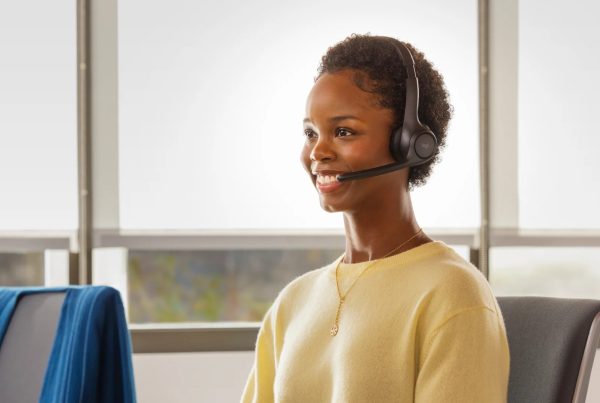
Wireless headsets are headphones with built-in microphones that connect to computers, phones or other compatible devices without requiring a permanent audio cable. Most business models use Bluetooth or a dedicated USB wireless receiver, giving employees greater freedom to move while remaining connected to calls, meetings and softphones.
For business use, a good wireless headset should do more than remove a cable. It should provide dependable connectivity, clear voice pickup, comfortable wearing, suitable battery life and compatibility with the communication tools employees already use.
This makes wireless headsets particularly useful for:
- Call centre and contact centre agents
- Sales teams
- Customer service employees
- Remote workers
- Hybrid employees
- Business executives
- IT and support teams
- Employees who frequently attend online meetings
Why Are Wireless Headsets Important for Business Communication?
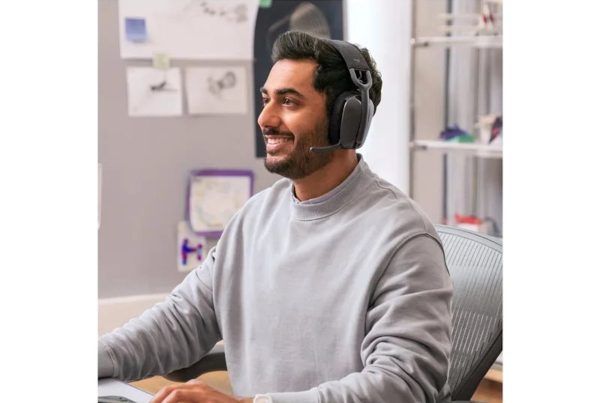
Wireless headsets make communication more flexible by allowing employees to move without being physically connected to a computer. For hybrid teams and employees who switch between devices, that flexibility can make everyday communication easier.
However, mobility is only one benefit. A professional headset can also provide a dedicated microphone positioned closer to the speaker’s mouth, helping calls sound more consistent than they might through a laptop’s built-in microphone.
Benefits of wireless headsets
- Greater mobility
Employees can move around their workspace while remaining connected to a call.
- Cleaner workstations
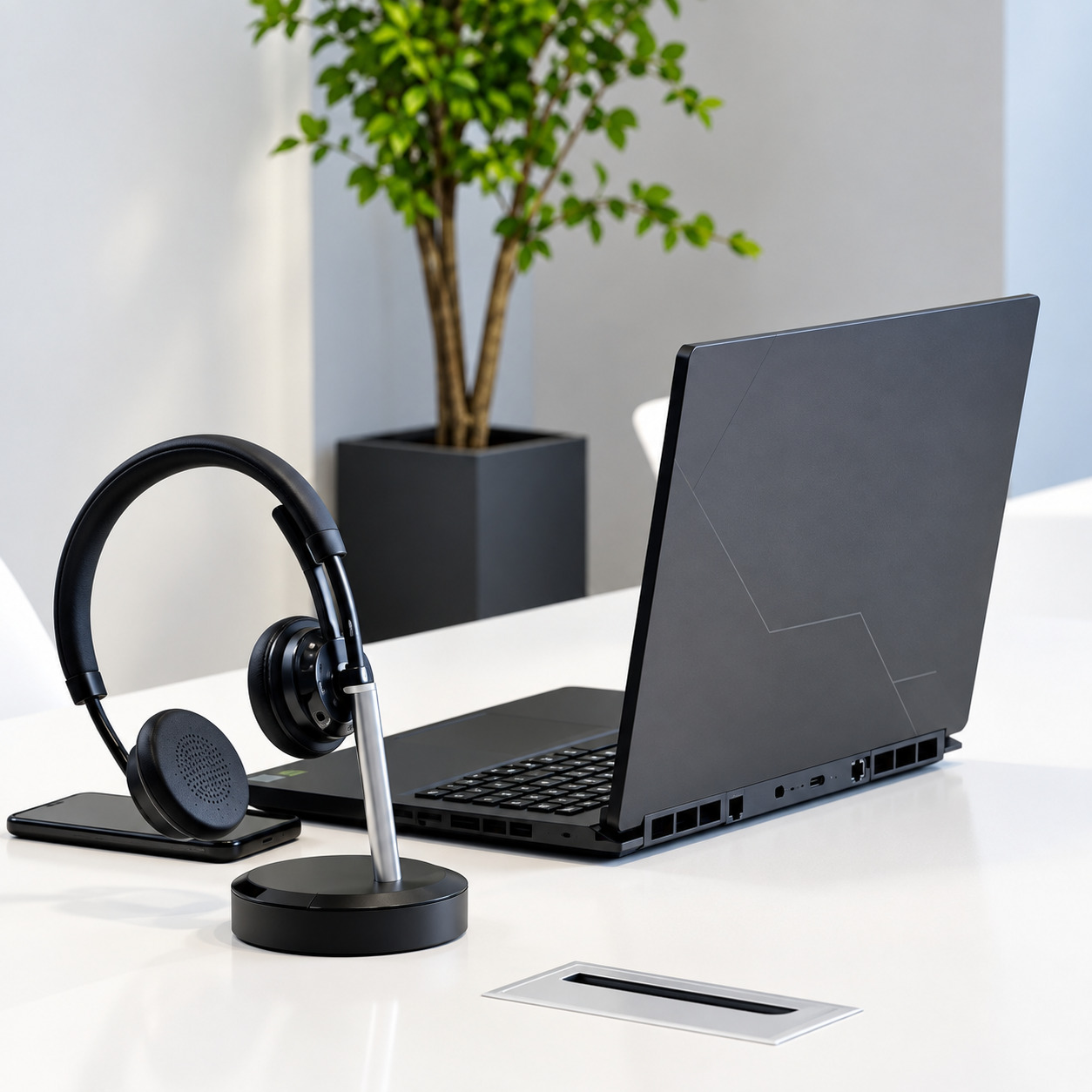
Removing an audio cable reduces cable clutter around desks.
- Hands-free communication
Employees can participate in calls without holding a phone or leaning toward a laptop.
- Better microphone positioning
A headset microphone is normally positioned closer to the user’s mouth than the microphone built into a laptop.
- Flexible device connectivity
Some business headsets can connect to more than one device, which is useful when employees use both a computer and smartphone.
- Better support for hybrid work
A single headset can become part of an employee’s daily setup at home, in the office and while travelling.
What Should You Look for in a Business Wireless Headset?
The right headset should be selected according to the employee’s actual working environment. A headset designed for occasional personal calls may not be the right choice for someone handling customer conversations for eight hours a day.
Here are the main specifications to consider.
1. Microphone quality
For business communication, microphone quality is often more important than music quality.
Look for features such as:
- Noise-cancelling microphone
- Environmental noise cancellation
- Multiple microphones
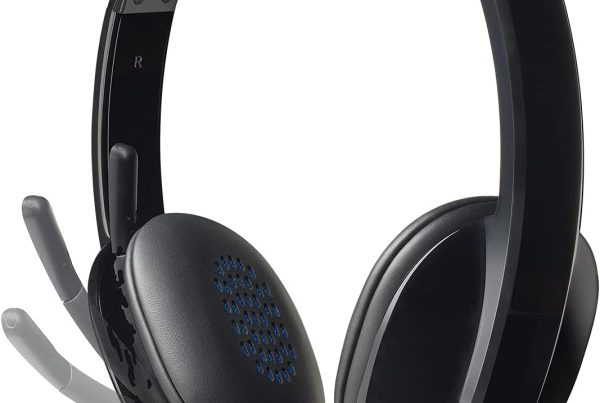
- Boom microphone
- Voice-processing technology
- Clear voice pickup
A call centre headset with mic noise cancelling is particularly useful when several employees work in the same room.
2. Active Noise Cancellation
Active Noise Cancellation, commonly called ANC, primarily helps reduce noise that the headset wearer hears.
For example, ANC can help reduce the impact of steady background sounds such as air conditioning, traffic or general office noise.
However, ANC should not be confused with microphone noise cancellation.
A headset can have excellent ANC while still having an average microphone. For business calls, you should evaluate both independently.
3. Microphone noise cancellation
Microphone noise cancellation focuses on the sound being transmitted to the other person.
This distinction is important.
Imagine a customer-service agent working in a busy contact centre. The agent may use ANC to hear the customer more clearly, while microphone noise cancellation helps prevent surrounding conversations from overwhelming the agent’s voice.
For this reason, a call center headset with mic noise cancelling wireless can be particularly valuable in busy workspaces.
4. Battery life
Wireless headsets depend on batteries, so battery capacity becomes an operational consideration.
For occasional meetings, a headset with moderate battery life may be sufficient. However, employees who spend most of their working day on calls need something designed for extended use.
Procurement teams should consider:
- Expected daily talk time
- Charging time
- USB-C charging
- Quick-charge capability
- Battery replacement options
- Whether the headset can operate while charging
Battery performance should always be considered alongside the manufacturer’s stated conditions because actual usage can vary.
5. Wireless connectivity
Bluetooth is common in wireless business headsets. However, not every Bluetooth implementation provides the same workplace experience.
Some professional headsets support a dedicated USB receiver as well as Bluetooth. This can be useful for employees who need to connect to a business computer and mobile device.
Bluetooth standards also include profiles that define how devices communicate and support different audio use cases. Therefore, procurement teams should consider the complete connectivity solution rather than simply looking at the Bluetooth version.
6. Dual-device connectivity
Dual-device or multipoint connectivity allows a compatible headset to maintain connections with multiple devices.
For example, an employee could have a laptop connected for Microsoft Teams while also remaining connected to a smartphone.
This can be useful for:
- Executives
- Sales representatives
- Managers
- Remote workers
- Customer-service staff
It reduces the need to repeatedly disconnect and reconnect devices throughout the day.
Best Wireless Headsets for Business Communication
There is no single headset that is automatically the right choice for every organisation. The best option depends on the employee’s role, environment, communication platform and budget.
The following models illustrate different approaches to business wireless communication.
Logitech Wireless Headsets
Logitech has a broad range of business communication products, including the Zone Wireless family.
The Logitech Zone Wireless 2, for example, combines Bluetooth connectivity with business-focused microphone technology, hybrid ANC and compatibility with major communication platforms. Logitech lists multiple microphones, Bluetooth connectivity and support for platforms including Microsoft Teams, Zoom and Google Meet.
For organisations that already use Logitech peripherals, standardising on Logitech headsets can also simplify device familiarity and management.
Suitable for:
Executives, hybrid workers, managers, professionals and employees who regularly attend online meetings.
Dell Pro Wireless Headset WL5022
The Dell WL5022 is another business-oriented option. Dell describes it as a wireless headset for computers and mobile devices, with controls for calls, volume, Bluetooth pairing and Microsoft Teams functionality.
This makes it worth considering for organisations that already operate Dell computer fleets.
Suitable for:
Corporate offices, IT-managed environments, Dell-equipped workplaces and employees who switch between computers and mobile devices.
VT FLOW Wireless ANC Bluetooth Headset
The VT FLOW is designed around hybrid work and wireless communication. Promallshop’s current listing describes it as supporting Hybrid ANC, ENC, dual-device Bluetooth connectivity and major UC platforms.
That combination makes it relevant for professionals who work between home and office environments.
Suitable for:
Hybrid employees, remote workers, managers and professionals who need both mobility and noise reduction.
VT9800 Wireless Bluetooth Headset
The VT9800 focuses on professional communication, HD voice, dual Bluetooth connectivity and an integrated busylight.
Its dual-device capability can be useful for employees who regularly move between a laptop and smartphone.
Suitable for:
Office workers, managers, remote employees and professionals who want a business-focused Bluetooth headset.
VTX300 BT Duo VT Wireless Headset
The VTX300 BT Duo VT is a dual-ear wireless headset designed for office, call-centre and remote-work environments. Its listed features include Bluetooth connectivity, a noise-cancelling boom microphone, cushioned earcups and compatibility with PCs, laptops, mobile devices and softphones.
Suitable for:
Call-centre agents, customer-service teams, remote workers and employees who spend extended periods on voice calls.
Wireless Headset Comparison
| Headset | Main Strength | Connectivity | Best For |
|---|---|---|---|
| Logitech Zone Wireless | Business meetings and professional communication | Bluetooth / receiver depending on model | Corporate and hybrid teams |
| Dell WL5022 | Business PC integration | Bluetooth / USB adapter | Dell-based workplaces |
| VT FLOW | ANC and hybrid work | Bluetooth | Remote and hybrid workers |
| VT9800 | Dual-device connectivity | Bluetooth | Mobile professionals |
| VTX300 BT Duo VT | Call-focused design | Bluetooth | Call centres and customer service |
The table should be treated as a starting point rather than a universal ranking. A procurement team should match the headset to its actual communication requirements.
Wireless Headsets for Call Centres
Call centres have different requirements from ordinary office users. An agent may spend most of the working day speaking to customers, so microphone performance, comfort and reliability become critical.
A call center wireless headset with mic should ideally provide:
- Clear voice pickup
- Noise-cancelling microphone
- Comfortable ear cushions
- Reliable wireless connection
- Adequate battery life
- Easy mute and call controls
- Compatibility with the organisation’s softphone
- Durable construction
What is the best headset for call centre work from home?
The best headset for call centre work from home is one that provides reliable connectivity, a clear noise-reducing microphone, comfortable long-term wear and enough battery life for the user’s shift.
The home environment also matters. A worker living beside a busy road, working in a shared apartment or operating from a room with background activity may benefit significantly from microphone noise cancellation.
Wireless Headsets for Hybrid and Remote Work
Hybrid workers often have a different problem: they need one headset that works across several environments.
A headset used at home may need to handle:
- Video meetings
- Customer calls
- Team calls
- Smartphone calls
- Music during breaks
- Switching between laptop and phone
In the office, the same headset may need to deal with conversations, air conditioning and other employees.
For these users, dual-device connectivity and noise management can be more valuable than features designed primarily for entertainment.
ANC vs ENC: What Is the Difference?
ANC reduces unwanted sound reaching the headset wearer, while microphone noise cancellation or ENC is designed to reduce unwanted environmental sound being picked up and transmitted during a call.
Think of it this way:
ANC: “What do I hear?”
Microphone noise cancellation: “What does the person on the other end hear?”
A professional business headset may use both technologies because they solve different communication problems.
This distinction is particularly important when evaluating a best call center headset with noise cancelling microphone.
Bluetooth vs USB Wireless Headsets
Bluetooth headsets are convenient because they can connect directly to compatible computers and mobile devices. USB wireless headsets typically use a dedicated receiver connected to the computer.
Bluetooth advantages
- Convenient pairing
- Good for laptops and smartphones
- Less hardware to carry
- Useful for mobile workers
- Supports wireless communication without a cable
USB receiver advantages
- Simple deployment on business computers
- Dedicated wireless connection
- Useful where Bluetooth availability is restricted
- Can be convenient for large-scale office deployments
For enterprise procurement, the best solution may be a headset supporting both.
How Much Should You Spend on a Wireless Business Headset in Nigeria?
The cost of a business wireless headset in Nigeria varies significantly by brand, model, features, warranty, connectivity and market conditions.
At the time of research, Promallshop’s wireless headset category includes models across different price levels, from professional Bluetooth headsets to higher-end ANC models.
Rather than choosing purely by price, organisations should calculate the value of the headset over its expected working life.
For example, a cheaper headset that causes frequent complaints, poor calls or early replacement may ultimately cost more than a better-specified model.
When purchasing multiple units, also consider:
- Warranty
- Bulk pricing
- Replacement availability
- Compatibility
- Employee comfort
- Battery performance
- Support requirements
Common Mistakes When Buying Wireless Headsets
Several mistakes can make an apparently good headset unsuitable for business use.
1. Choosing based only on sound quality
A headset can sound excellent for music while having an unsuitable microphone for professional calls.
2. Confusing ANC with microphone noise cancellation
These technologies address different problems.
3. Ignoring compatibility
Always verify compatibility with the organisation’s operating systems, softphones and communication platforms.
4. Forgetting battery management
A wireless headset that runs out of power halfway through a shift can become an operational problem.
5. Buying one model for everyone
Executives, call-centre agents and field workers may have completely different requirements.
6. Ignoring comfort
If employees wear a headset for several hours every day, weight, padding and fit matter.
How IT Managers Can Standardise Wireless Headsets
A structured procurement process can make headset deployment much easier.
1. Segment employees
Group users according to their work:
- Call-centre agents
- Managers
- Executives
- Remote employees
- Field employees
- Reception and customer-service staff
2. Identify platforms
Document whether employees use:
- Microsoft Teams
- Zoom
- Google Meet
- VoIP applications
- Softphones
- Mobile phones
- IP desk phones
3. Define minimum specifications
For example:
- Noise-cancelling microphone
- Bluetooth
- USB receiver where necessary
- Minimum battery requirement
- Dual-device connectivity
- Comfortable over-ear or on-ear design
4. Test before bulk purchasing
Give representative employees several models to test in real working environments.
5. Standardise approved models
Instead of allowing every employee to buy a different headset, create an approved device list.
This simplifies support, training, replacements and future procurement.
Best Practices for Wireless Headset Deployment
A successful headset rollout involves more than handing employees a box.
Create a charging routine. Employees should know when and where headsets should be charged.
Provide basic setup guidance. Explain Bluetooth pairing, USB receiver installation and microphone selection.
Test the microphone. Employees should make a test call before joining important meetings.
Keep firmware updated. Where manufacturer software supports firmware updates, IT teams should include this in device maintenance.
Maintain spare units. Critical call-centre operations should have replacement equipment available.
Monitor employee feedback. Comfort and usability problems may not appear during procurement testing.
Microsoft Teams also provides device settings that allow users to select microphones and speakers, manage supported Bluetooth devices, adjust noise suppression and make a test call.
The Future of Wireless Business Headsets
Business headsets are becoming more intelligent. Modern models increasingly combine multiple microphones, AI-based voice processing, improved noise suppression, multipoint connectivity and software-based device management.
For organisations, the most important development may not be better music playback. It is the growing ability of headsets to understand the difference between a user’s voice and surrounding environmental noise.
This is especially relevant as hybrid work, virtual meetings and cloud-based communication continue to make audio a core part of workplace collaboration.
The future business headset is therefore likely to be less like a simple pair of headphones and more like an intelligent communication endpoint.
Conclusion
Wireless headsets have become an important part of modern business communication. They provide mobility, hands-free calling and a practical way to improve voice communication across offices, call centres and hybrid workplaces.
For Nigerian businesses, the buying decision should focus on the actual working environment. A call-centre agent needs reliable voice pickup and comfort, while a manager may prioritise multipoint connectivity and meeting-platform compatibility.
Brands and models such as Logitech, Dell, VT and other professional headset manufacturers offer different approaches to these requirements. The key is to compare microphone performance, connectivity, battery life, comfort and compatibility before making a purchase.
For businesses buying multiple units, testing a small number of models before a full deployment can also reduce procurement mistakes and help employees get equipment that genuinely suits their daily work.
FAQs
The best wireless headset depends on the user's role and environment. Business users should prioritise microphone quality, comfort, battery life, connectivity and compatibility with their communication platforms rather than choosing solely by brand.
Yes. Wireless headsets can be useful in call centres because they give agents more freedom of movement. For call-centre environments, however, microphone noise cancellation, battery life, comfort and connection reliability are particularly important.
A call centre headset with mic noise cancelling uses microphone technology to reduce unwanted environmental sounds being transmitted to the person on the other end of the call. It is different from ANC, which primarily reduces noise heard by the headset wearer.
A suitable headset for call-centre work from home should have a clear microphone, effective background-noise reduction, comfortable ear cushions and sufficient battery life. Dual-device connectivity can also be useful for workers who use both a laptop and smartphone.
Yes. Bluetooth is widely used for wireless communication devices. However, businesses should verify compatibility with their computers, smartphones and communication platforms before purchasing in bulk.